
By Shmully Blesofsky

Crown Heights development map circa 1906. Albany and Eastern Parkway Saloon
We’re all familiar with the Southwest corner of Eastern Parkway and Albany Avenue, the new luxury condominium building. This building has always symbolized the new wave of development in Crown Heights. That corner has an interesting history, so let’s explore it’s history.

The Brooklyn Daily Times August 15, 1871. Office of the Street Commissioner seeking proposal for grading Albany Avenue and Eastern Parkway. Eastern Parkway was originally Sackett Street.
In the early 1870s, shortly after Eastern Parkway (then referred to as “The Boulevard”) was built and Albany Avenue was graded, John Lutz and his wife, Margaret, developed lots along Albany Avenue, stretching from Eastern Parkway to President Street, originally part of the Z. Coffin Farm.

Brooklyn Evening Start 1848 John Lutz Night Scavenger
They built a two-story main house with an attic for their family and two smaller rental houses. Lutz, who had worked as a night scavenger since the 1850s, was hailed as “an upright, honest man despite his modest means” after returning a lost woman’s pocket book, as reported in the local paper. The Lutz’s daughter was also named Margaret.

Brooklyn Eagle, New York • Mon, Feb 14, 1870. A tribute from Mrs Lang to John Lutz the night scavenger and was in the “lower walks of life” but still returned the women’s pocket book.
When financial difficulties arose due to high tax assessments, John E. Greany, Margaret Lutz’s husband and a prominent Brooklyn politician, intervened. Greany argued that Eastern Parkway construction had reduced the property’s size and that rental income barely covered costs.

Brooklyn Eagle Dec 14, 1881. John Greany argued that Eastern Parkway cut off the backyards which means that the houses faced Union Street for privacy and that the Lutz family probably lived there before the city developed Eastern Parkway.
The Greany family became integral to the property’s story. John E. Greany, born in England in 1820, immigrated to Brooklyn, where he climbed the political ladder to become supervisor of the 24th Ward. Holding various city positions despite accusations of corruption, Greany later became a contractor. The so-called “Greany gang” was accused of giving bribes for city contracts by lending money to local politicians. Greany also founded the “John E. Greany Association” and promoted political registration within the neighborhood.
Brooklyn Eagle Tue, Sep 07, 1886. John Greany and the ‘Greany Gang’ accused of corruption
In the 1890s, after Margaret Lutz’s parents passed, the Greanys moved into 324 Albany Avenue. In 1894, they applied for permits and transformed the main house into the Nassau Inn, adding a 12×60 wagon shed for guests’ who traveled. Known by various names over the years—Nassau Inn, Driver’s Rest, Uncle John’s, and Con Duffy’s Casino—the hotel became a celebrated community fixture. The inn was later described as a “famous landmark in Brooklyn.” Recalling Crown Heights’ “Eastern Parkway Golf Links” era from 1901 to 1909, Brooklyn old-timer Jay Wrenn noted, “after a day of golf, everyone would hasten to the Old Nassau Inn at Albany Avenue and the Boulevard.”

This 1905 picture of Union Street between Kingston and Brooklyn shows Nassau Inn on the far right. There’s no development on Union or Kingston so you have a clear view of Nassau Inn on Albany and Eastern Parkway

Circa 1906 men golfing on what is now Crown Street and the Nassau Inn can be seen on top of the hill on Eastern Parkway. The structure to the left is now the Berman mansion turned Lubavitch Youth Organization. Back then it was a one story golf club. The far left are Union Street houses.

Brooklyn Eagle, New York • Sun, Feb 25, 1951 old timer Jay Wrenn talking about Nassau Inn
By 1900, as Crown Heights developed, the Greanys sold much of their property to the Eastern Parkway Company but retained the Nassau Inn. Over time, however, the inn—by then managed by Peter Glenn and Mary Meyers—acquired a notorious reputation as a “disorderly house,” often associated with gambling and prostitution. Glenn, a former Salvation Army member, insisted he ran a respectable establishment, but mounting complaints prompted action.

3 structures are the Nassau Inn and the two homes they rented out. It also shows you the 12×60 wagon shed for guests. They placed the structures closer to Union Street when they were actually closer to Eastern Parkway
Father Smith of St. Gregory’s Church, in collaboration with local developer Frederick Rowe and District Attorney Louis Goldstein, led a campaign to shut down the inn. In court, many residents, including R.M. Johnson, who lived nearby in a building on Albany and Union that would later become the ladies’ mikveh, testified against the Nassau Inn about its negative impact on the community. Justices Forker, Fleming, and Herman eventually fined Glenn and Meyers $200 each and ordered the inn closed, marking the end of its notorious chapter. By 1915, the hotel was torn down.

Brooklyn Eagle Fri, May 22, 1914 Evil Resort on Eastern Parkway.
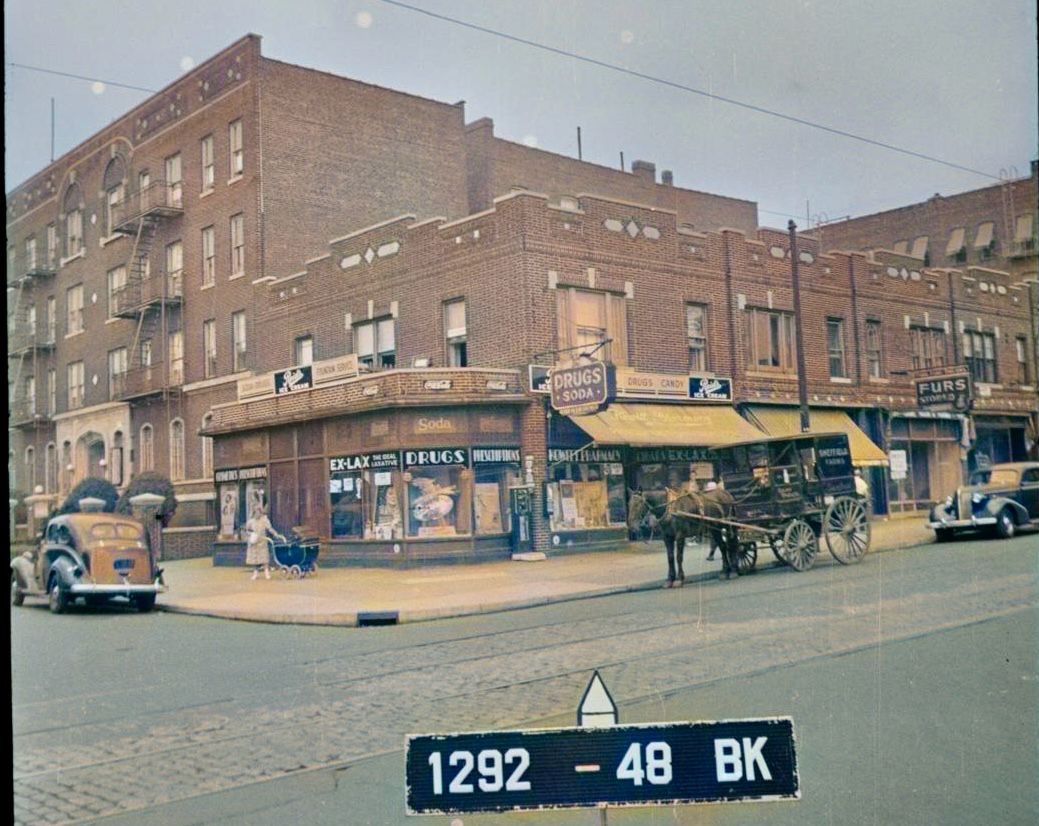
In the early 1920s, a brick two-story building with stores and apartments was erected on the lot, transforming it into a bustling commercial area. Throughout the 1920s to the 1990s, Eastern Parkway and Albany Avenue hosted an array of establishments and residents, each adding to Crown Heights’ character. In 1921, the Brooklyn Citizen published a help-wanted ad for the Maltov family at 862 Eastern Parkway. Over subsequent years, local figures such as dentist Dr. Louis Cample (1924) and attorney Irwin Weinstein (1926) resided along this stretch. In 1939, Benjamin Burdman and Rebecca Burdweiz, who lived at 864 Eastern Parkway, were listed as members of the Communist Party of America.
Along Albany Avenue, the property saw an eclectic mix of businesses started by local businessmen from the neighborhood, including Harry Schinz’s auto supplies in 1924 and, in 1926, Madam Nellie’s Beauty Parlor and G&G Gift Shop. From bustling businesses to community organizations, these addresses reflect the area’s layered history and ongoing evolution. Over the years the building traded hands and was eventually owned by a local Lubavitch family and a local Yeshivah.
In 2001, a developer named Hayshe Deitch saw the corner building was for sale and was inspired by the Rebbe’s idea of ‘Khan Tzivah Hashem Es Habracha’ and the concept of Shnas Habinyan, a period during which the Rebbe greatly encouraged construction of any kind. Driven by the idea of building something valuable for the community, Deitch embarked on creating luxury condos. In 2001, ground was broken, and the impressive building that stands today was completed, offering 23 beautiful condos ranging from one-bedroom to three-bedroom units, with upper floors providing views of the city and a comfortably laid out branch of the Apple bank.

Nassau Inn 1905
 Demolished Nassau Inn, 1915
 Circa 1940 Albany and Eastern Parkway, built in the early 1920s. Albany Bakery was part of the building as well but that will be a separate article.
 Albany and Eastern Parkway, built in the early 1920s. Circa 1940

New Condo building Circa Today.
Copyright (c) Shmully Blesofsky all right reserved.
For questions or feedback or permission HistoryofCrownHeights@gmail.com

 History of Crown Heights
Leave a comment